

This is the first of three talks given by Mariah Kochis at the 2026 Feast of Ideas Retreat. Her plenary talks focused on Homeschooling Through the Storms.

I want to begin tonight with a bit of vision. Before you is a painting by J. M. W. Turner titled Snow Storm. Let’s take a few minutes in small groups to observe it together.
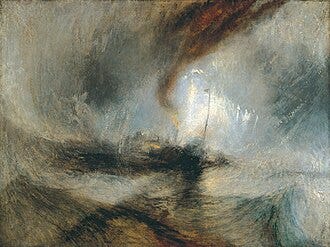
We’ve all had homeschool days, weeks, months, and even years where nothing goes as planned. Just when we think, “Okay, I’m handling this pretty well,” everything suddenly goes sideways. In those moments, it becomes painfully clear: I cannot be the captain of this ship. I am not actually steering anything. I’m simply doing my best to be faithful.
Some days, this looks like washing nacho cheese out of your hair after your neurodivergent child threw it at you during a meltdown. Some days, it’s answering phone calls from hospice in the middle of a Spanish lesson. Some days, it’s a list of readings on post-it notes that never get done because you have to pack everyone up and head to the hospital. People before books—you learn that from the storms. And yet, education is still happening.
Charlotte Mason understood this reality, and she never urged us to become the hero of the homeschool. Instead, she pointed us again and again toward Christ—toward the One who truly leads and sustains. Her philosophy reminds us that education is not a checklist but a way of life—formed by atmosphere, discipline, and life itself. Books, lessons, and even methods are tools, but they are not the anchor. The anchor that holds us is not a philosophy. It is not even Charlotte Mason’s wisdom. The anchor is a Person—Jesus.
She writes in Parents and Children,
“We hold that the Spirit of God is Himself the supreme Educator of mankind.”
and again,
“There is no part of a child’s home life or school work which the Divine Spirit is not contending for. He is ever at hand to sanctify every act and word and thought.”
If our days feel ordinary or even like we’re in a trench or a storm, that’s exactly where the Spirit wants to work in us. I learned as a young mom that praying for us to have a good day was like praying for patience. The Lord’s good day for me would be one in which I was sanctified.
This is very good news for us as we homeschool through storms. I chose this painting for our opening tonight because it helps us shift perspective. The movement, the motion, the sense of being caught in something larger—there’s something here we can work with.
More often than not, we aren’t homeschooling under calm skies. There may be illness, special needs, grief, exhaustion, financial or marriage strain—and all the while we are trying to point our children toward truth, goodness, and beauty while treading water ourselves. We may wonder if any of it is even worth it, or if we’re doing something terribly wrong. Our homeschools may not resemble anything we see on social media—and maybe, that’s ok.
Just as we can look at this painting of a storm and still call it beautiful, my prayer is that by the end of our time together, you will be better equipped to face the unique storms you encounter—able not only to endure them, but to see the unexpected beauty God is shaping through them as well.
With the understanding that Christ is our anchor, Miss Mason gave us more than a set of principles or techniques. She gave us a way to navigate the storms through a living, Spirit-led method of education. Method, she reminds us, is not a rigid system or a checklist to be followed perfectly. It is a natural, flexible, end-directed way of guiding our children’s formation—working with life as it unfolds rather than trying to bend life to our schedule or expectations. And it is precisely in stormy, unpredictable seasons that her distinction between method and system becomes a lifeline for both parent and child.
Let’s look closely at what Charlotte Mason actually says about method.
First, method implies an end and a way to reach it. She writes:
“Method implies two things—a way to an end, and a step-by-step progress in that way. Further, the following of a method implies an idea, a mental image, of the end or object to be arrived at. What do you propose that education shall effect in and for your child?”
Home Education, p. 9
The end isn’t simply memorizing facts, finishing assignments, or eventually graduating. The end is formation—developing a child’s will, love, attention, and habits of a good life. The method gives us a mental picture of that goal, guiding our daily decisions. My favorite literary character to think about here is Samwise. As he walked with Frodo to Mordor, his determination wasn’t born from a to-do list or even a complete understanding of how to get from here to there; it was an almost involuntary response of his will based on his ideas about friendship.
Reflect: What ideas or mental image of education can begin to shape your will as the mother-educator?
Second, method is natural:
“Method is natural; easy, yielding, unobtrusive, simple as the ways of Nature herself; yet watchful, careful, all-pervading, all-compelling.”
Home Education, p. 9
A true method flows with the rhythms of life—gently shaping the child without forcing or controlling, even in the middle of a chaotic day.
Reflect: Where in our homeschool does learning flow naturally, without forcing it, and where do you try to push growth that might need to be released to the Spirit?
Third, education happens through all of life:
“Does the child eat or drink, does he come, or go, or play—all the time he is being educated, though he is as little aware of it as he is of the act of breathing.”
Home Education, p. 9
Every ordinary act—meals, walks, play, conversation—becomes part of formation. Life itself is the curriculum.
Reflect: Think of a recent stormy time in your homeschool. What lessons did your children learn? What did you learn? Often, the academics are the easiest part.
Fourth, Charlotte Mason warns that the method can become a checklist:
“There is always the danger that a method, a bona fide method, should degenerate into a mere system.”
Home Education, p. 9
A system promises measurable results, predictability, and comfort. But it is mechanical. It may strengthen memory, reasoning, or dexterity, but it cannot cultivate love, attention, or a rightly-ordered will.
Reflect: Think about your timetable or lesson plan– have you ever clung to it as if redoing it perfectly could calm the storms in your homeschool? What does that reveal about where you’re placing your trust?
Finally, education is living, spiritual work belonging to God:
“The parent who sees his way … to educate his child, will make use of every circumstance of the child’s life almost without intention on his own part, so easy and spontaneous is a method of education based upon Natural Law.”
Home Education, p. 9
The Spirit is the supreme Educator, shaping the child’s soul through every moment. Our job is not to control the storm but to participate faithfully as we are guided by a method, anchored by Christ, and led by the Spirit who is already at work in our homes.
Reflect: How might working on your own habit of attention and thought of God change the way you approach your homeschool?
When the day feels chaotic—glitter everywhere, meltdowns in progress, and the schedule completely undone—remember: method is alive. It flows through real life. It guides without forcing. It lets Christ be the Captain. It keeps us Spirit-led rather than system-driven.
So the natural question becomes: how do we anchor our intentions and habits in the day so that method isn’t just a beautiful idea on paper, but a lived reality—even in storms?
In Parables from Nature, in the story “Training and Restraining,” we read of the lament of the gardener: ‘...the wind has torn away these poor things from their fastenings… and the end is, that my beautiful garden is turned into wilderness.’ Like in a garden without support, this can happen in our homeschools when there is no intentional rhythm or guided structure.
When we say that Mason’s method is “natural,” we don’t mean unrestrained. Natural growth still benefits from guidance, boundaries, and support. Think of a vine climbing a trellis: the vine grows on its own, reaching toward the sun, but the trellis provides direction and prevents it from tangling or collapsing. Similarly, in our homeschools, children can explore, think, and act freely while still being supported by habits, expectations, and gentle correction. Natural and restrained are not opposites– they work together to produce growth that is both flourishing and formed. It is in this context that Charlotte Mason’s philosophy can rightly be called child-led.
Her principles work like a living trellis. They offer support, guidance, and a framework for formation– formation of ourselves, our children, and our family culture– without ever coercing growth. Instead, they help both parent and child reach toward the true end of education: a rich, disciplined, loving life formed in God.
In your packet, you’ll find a printout of Mason’s 20 principles. I encourage you to read through these and volume 6, A Philosophy of Education, to better grasp the vision of education she has laid out for us.
Her principles aren’t just curriculum approaches or teaching techniques. They are a way of viewing the child, the world, and God’s work in us. At the heart of her philosophy is the conviction that children are born persons who are whole and complete, entrusted to our care, made in the image of God.
Education, then, is not a list of tasks to finish, but a way of life—an atmosphere, a discipline, and a life. Her principles call us to cultivate habits, attention, and character while keeping Christ at the center of our homes. They serve as the trellis that supports growth without forcing it, the framework that allows learning to flourish in every moment of ordinary life.
Understanding this helps us see that education is the formation of the whole person—not merely the accumulation of facts—and that every ordinary day, every routine, and every conversation can become an opportunity for growth, love, and wisdom.
With that in mind, let’s look at a practical way to anchor Charlotte Mason’s principles in our daily lives: through a Rule of Life.
The idea of a Rule of Life came from the Benedictine tradition, dating back to St. Benedict in the sixth century. A Rule was a rhythm for daily living, ordering the monk’s day around God through prayer, work, study, rest, and hospitality. Benedict wrote, “Let all things be done in a fitting and orderly way,” emphasizing that intentional habits and rhythms help cultivate virtue and sustain life in the midst of human frailty. Like a trellis supporting a growing plant without bending it, a Rule provides a framework that allows spiritual and practical formation to flourish naturally. It is especially fitting for mothers because motherhood is already itself a life shaped by limits.
In the book Domestic Monastery, the author observes that a mother is often forced into maturity simply because her time is no longer her own. Her needs are repeatedly set in second place–not always by choice, but by necessity–and this steady surrender, the book suggests, would mature almost anyone. This is not an argument for neglecting the self (we’ll discuss this in another talk), but a recognition that formation often comes through constraint.
A rule of life gives form to that constraint. It does not add burden to an already demanding vocation; it brings intention to what already exists. Instead of being shaped only by interruption and urgency, the mother is shaped by prayer, rhythm, and faithful return. Her days are no longer reactive, but responsive. In this way, the rule becomes a trellis–not denying the reality of sacrifice, but ordering it toward love, stability, and growth.
Charlotte Mason’s principles resonate beautifully with this approach. She reminds us that education is an atmosphere, a discipline, a life. Every ordinary moment—eating, walking, playing, conversing—is an opportunity for formation–for maturity, for all. As she writes,
“There is no part of a child’s home life or school work which the Divine Spirit is not contending for. He is ever at hand to sanctify every act and word and thought.”
Parents and Children, p. 273
Like the trellis, her principles support growth without force, guiding children and parents toward their proper ends while leaving the Spirit free to work.
We often liken learning to a “feast”—however, this isn’t simply academic. It’s a rich, varied banquet of ideas, experiences, and encounters in all of life. To pull “from the feast” means to draw thoughtfully from all that life offers, rather than cramming knowledge into rigid compartments or treating lessons as isolated tasks. It is about selecting what nourishes the mind and heart, savoring it, and allowing it to shape our children—and ourselves—over time. Maybe you’ve heard that men are like waffles and women are like spaghetti. Maybe so. Education, likewise, isn’t a waffle; it’s spaghetti.
When we approach education in this way, it becomes a living part of life, woven into daily rhythms and ordinary moments. A Rule of Life, then, is a practical framework for harvesting and integrating this feast, ensuring that learning, reflection, and the formation of character flow naturally into the life we live together as a family.
When considering our born family over the years, a Rule of Life has looked something like this:
Focus: Prayer and Communion
Guiding Question: “How will we keep Christ central in the ordinary moments of our home and homeschool?”
Example: Read children’s Bible lessons at breakfast, sing hymns before bed, or take a short mid-morning nature walk while naming things you see and thanking God—essentially, some version of a morning time, if possible. Be intentional in conversations, in cultivating that thought of God, and in sharing thoughts with the kids. Work on praying with the children in both structured times and spontaneous moments.
Focus: Work and Duty
Guiding Question: “How will we steward responsibilities with love?”
Example: A simple list of morning chores for the kids on post-it notes, habit-stacking afternoon chore time onto read-alouds, loud music included for fun, considering volunteer opportunities thoughtfully, and modeling through doing the work the Lord has asked me to do.
Focus: Study and the Mind Life
Guiding Question: “How will we nourish the mind?”
Example: That might look like an ideal day full of rich engagement, or perhaps simply one living book, one narration, and a bit of math—small, consistent acts that feed the mind. Audiobooks with lunch. Grand conversations in the car on the way to and from errands or activities. Keep the kiddos accountable with mom meetings.
Focus: Rest and Delight
Guiding Question: “How will we make space for wonder and joy?”
Example: Nature journaling, other forms of keeping, artist study, handicrafts, and yes—even playing video games together. Say no to more outside obligations. Practice contentment. Keep a gratitude journal together.
These practices, many drawn straight from the feast, become the rungs of the trellis, supporting the growth of habits, love, and attention without forcing. Faithfulness, not fullness, measures the feast. When storms come, a strict timetable can feel overwhelming, I know it did me, but breaking the day into these guiding ideas has helped me maintain anchored intentions both when the children were smaller and now. It has helped me to sort through all that’s impressive and find what’s enough.
As the principles and these practices form the rungs of your homeschool trellis, it becomes essential to notice how the vine—your child and your home—is actually growing. This is where Charlotte Mason’s idea of the mother’s diary comes in. Keeping a brief record of habits, progress, and moments of growth or struggle—both academic and spiritual—allows us to notice patterns, adjust rhythms, and remain attuned to the child’s personhood.
Celeste Cruz, in our Mother’s Best issue of Common Place Quarterly, shared this quote from the Parents’ Review:
“I would earnestly exhort all young mothers to keep a journal in which the gradual progress and unfolding of their children’s minds may be noted down. Even if they have no general views in so doing, they will derive much benefit from it; their ideas will become more collected, their plans more determined, and they will acquire a habit of thoroughly examining and endeavoring to understand whatever occurs to excite their attention… words, ideas, knowledge, feelings—everything, in short, which is either naturally unfolded in the mind, or acquired by education, should be here recorded; together with the first appearance of every endowment, and every defect, the original source of which would thus be open to our consideration… nor would it be long before the task of keeping it would become to the mother the most interesting of employments.”
I want to encourage you not to get lost in the notebook aspect of this habit. Keeping a diary can be as simple as opening a notes app on your phone, giving each child a separate note, and jotting down thoughts, questions, and observations while making dinner or waiting in the car to pick up groceries. Even brief entries—what went well, what felt difficult, where God’s presence was noticed—can anchor us in Christ, remind us of our intentions, and preserve a record of growth through the storms of life. By keeping this practice small, portable, and adaptable, it becomes achievable even on the busiest or most chaotic days, allowing the feast, the trellis, and our anchored intentions to be observed, celebrated, and adjusted with love.
Reflection is key. At the end of the day, week, month, or term, jot down a few notes. As your children grow and life inevitably gets busier, this small habit frees you to love, teach, and live with intention. Many times, I think of something to share or a question I want to ask my young adult, only after she has left for work. Having my notes app handy means I can pin it there and not rely on my “grief brain” to remember between laundry and dinner later that evening.
I want to ask you: when did you last notice a small but meaningful moment of growth in your child that might have gone unnoticed if you hadn’t paused to observe? Has your child ever had a struggle, and it wasn’t until afterwards that you realized many signs went unnoticed? How might keeping a brief record of these moments change the way you see your days?
All of this will naturally lead us, then, to a thinking love:
“The mother is qualified,” says Pestalozzi, “ and qualified by the Creator Himself, to become the principal agent in the development of her child;...and what is demanded of her is–a thinking love…God has given to thy child all the faculties of our nature, but the grand point remains undecided–how shall this heart, this head, these hands, be employed?...”
Home Education, p.2
Mason reminds us that education is not just about forming habits or transmitting knowledge; it is love expressed with intelligence and discernment. A thinking love notices the child as a born person, responds with patience, and observes the child with all the effort we ask for in watercoloring a flower into our nature journals. We’ll take this idea deeper in the next talk.
By pairing the trellis, the Rule, and daily habits with a thinking love, we ensure that our homeschools are formed by intention, anchored in Christ, and responsive to the child’s real needs. Even in stormy seasons, it is not perfection that matters, but faithfulness—the small, repeated acts of love. Even in the storms, we will begin to see the fruit of our efforts.
As we draw this first talk to a close, remember that homeschooling—and life itself—will always bring storms. We cannot control every wave, meltdown, or unexpected challenge. There is no perfect formula for a Charlotte Mason education, no matter how perfectly curated our timetables are. Again, and I can’t stress this too much, faithfulness, not perfection, is the measure of the feast.
I want to share a poem I wrote that captures what I’ve learned in these stormy seasons; a reminder that stillness, formation, and anchored living are not about holding tight to control, but about releasing, trusting, and resting in the currents that carry us. It ties in nicely with the painting we’ve studied. When my oldest and I were working our way through The Riot and the Dance for high school biology, I found myself very interested in, of all things, algae. I read, ‘The basic structure of the plant-like brown algae consists of a root-like base called a holdfast. This is not a true root because the function of water and mineral absorption (which is typical of plant roots) does not occur in the holdfast. Rather, the holdfast simply serves to anchor the alga firmly to a hard underwater surface (typically rock, seashells, wood pilings of docks and piers, etc.) They don’t like soft-shifting surfaces like sand or mud.”
In a stormy season in our homeschool, becoming a caretaker for my mom and a child experiencing autism burnout (but not knowing that was what that was at the time) while still healing from an appendix rupture myself, the science of relations met me in this idea.
To be still, I thought I had to hold still,
Tightly gripping my Very Little,
Drowning, yet faithful.
But the current whispered to me,
“Release it.”
I loosened my grasp
And learned I was still
Planted in the sea—
Held fast in the Holdfast—
And stillness washed over me
In the ebb and flow of the tides.
I flutter about,
Sustained by the currents.
With that fish out of water feeling.
I keep practicing
Letting go and not being God
And find this looks like grace
In the moving lull
Of the current.
As you reflect on this poem, talk, and the questions today, let’s be inspired to:
Anchor ourselves in Christ. Remember that He is the captain of our homeschools and our lives.
Set up our trellises. Establish habits, rhythms, and intentional acts that support growth without forcing it.
Practice a thinking love daily. Respond with patience, intelligence, and discernment.
Observe and Reflect. Notice the work God is doing in our children, in us, and in our homes.
Release Control. Trust the currents of His grace, even when the day feels like pure chaos.
Let’s pray.
Lord, help us build lives and homeschools where faithfulness matters more than perfection, where grace is visible even in the storms, and where every ordinary moment becomes a step toward love, attention, and virtue. Amen.